
How to decorate a mantel without fireplace starts with one mindset shift: you’re not “faking” a hearth, you’re building a focal point that feels intentional, balanced, and useful in your room.
If you’ve got a shelf or mantel ledge on a blank wall, it can look awkward fast, either too empty, too cluttered, or like you’re trying to copy a fireplace moment that your space simply doesn’t have. The good news is that a mantel is really just a long styling surface, which means the same design rules apply as any console, bookshelf, or credenza vignette.
In this guide, you’ll get a few proven layout formulas, a quick self-check to diagnose what’s “off,” and practical steps for different styles and room types. I’ll also flag common mistakes, plus when it’s worth calling in a pro, especially if you’re mounting heavy items.
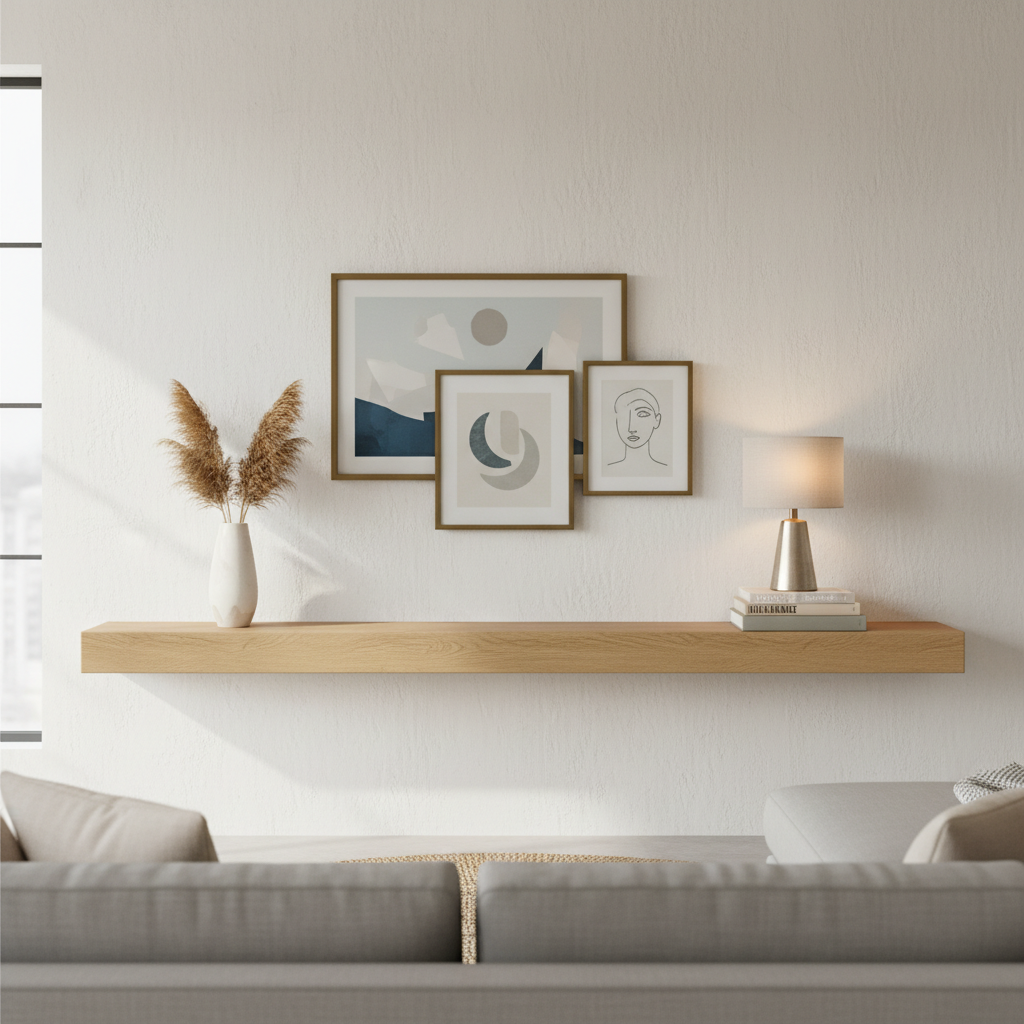
Decide what your mantel is doing in the room
Before you move a single object, decide the mantel’s job. A fireplace mantel naturally says “gather here,” but a mantel without one can be a lot of different things, and the decor changes depending on the role.
- Visual anchor: You want the wall to stop feeling empty, especially in open-plan rooms.
- TV companion: The mantel supports a media wall, without competing with the screen.
- Entry or hallway moment: A quick “welcome” vignette, often cleaner and slimmer.
- Seasonal swap zone: A stable base with a few easy rotating pieces.
According to National Association of Home Builders (NAHB), built-ins and intentional storage features are often valued in home design, and a mantel shelf can read like a built-in detail when it’s styled with purpose. You don’t need a firebox to get that effect, you need a clear visual function.
Measure first, then pick a layout formula that rarely fails
Most styling problems are scale problems. If the shelf, art, and objects don’t “agree” on size, the arrangement feels random even when the pieces are nice.
Quick measuring rules (use these as guardrails)
- Art width: Aim for 60–90% of mantel width for the main art or mirror.
- Art height above shelf: Often 4–8 inches gap looks intentional, adjust for ceiling height.
- Object heights: Mix tall, medium, small, but avoid having everything the same height.
Three easy formulas
- Classic centered: One large mirror/art in the middle, two groups on the sides.
- Asymmetrical “gallery lean”: One large piece leaning, layered with smaller frames and a tall object on the opposite side.
- Pair + anchor: Two matching lamps/candlesticks with a bold center piece (works well in formal rooms).
If you’re stuck, pick one formula and commit. “A little of everything” is usually what makes a mantel look messy.
Self-check: why your mantel looks off (and what that usually means)
When people search how to decorate a mantel without fireplace, they’re often reacting to a vague feeling that the wall looks unfinished. Here’s a fast diagnosis list.
- It feels top-heavy: Your art is too large or too high, or you have only tall items without a base layer.
- It feels skimpy: The main art is too small for the shelf length, or everything is pushed to the center.
- It feels cluttered: Too many small decor items, no negative space, and no “hero” piece.
- It looks like a fake fireplace: Overuse of lanterns, faux logs, or tools that imply a firebox.
- It fights the TV: Reflective mirror glare, bright frames, or busy patterns too close to the screen.
Pick the one description that matches most, then solve that single issue first. This is where styling gets easier, because you stop changing everything at once.
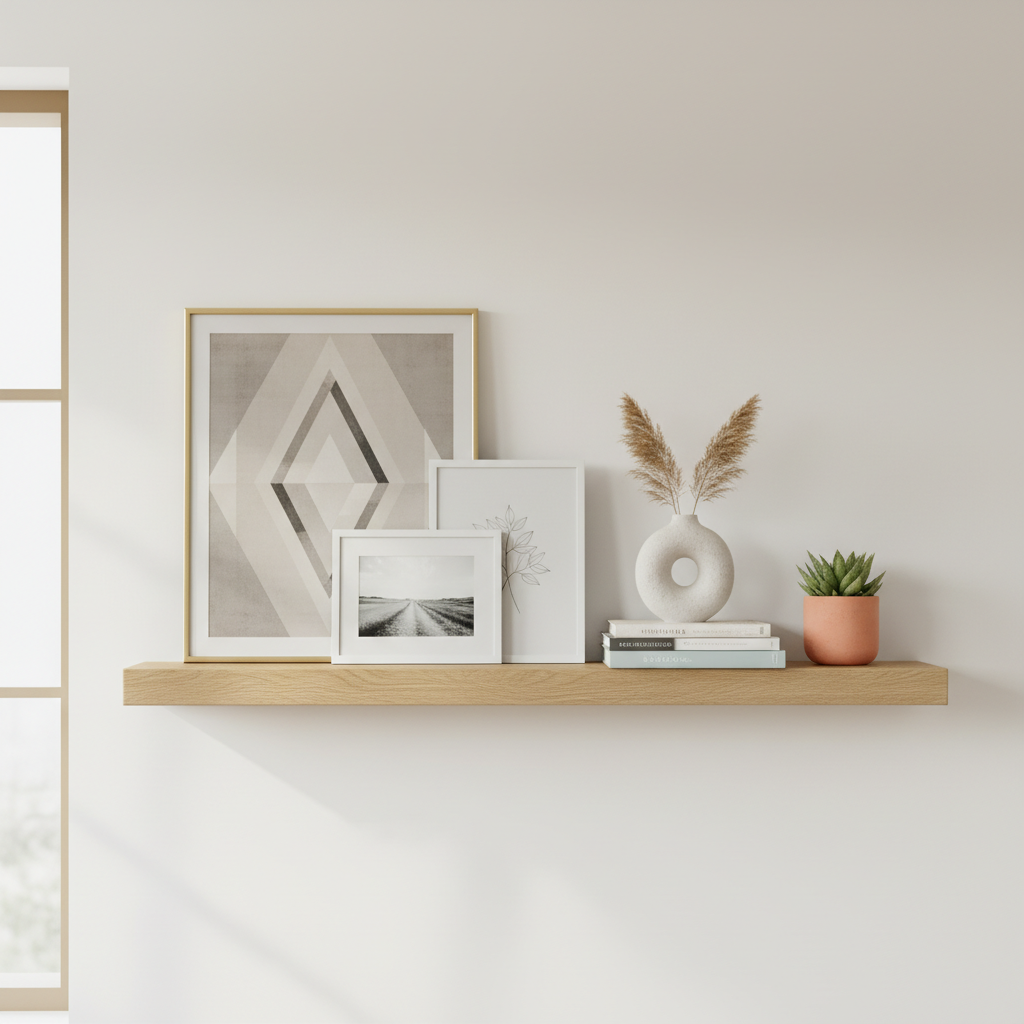
Build your mantel in layers (this is the “editor’s” method)
If you want a mantel that looks styled but not overdone, build it in layers. You can do this in 10–15 minutes once you get the hang of it.
- Layer 1: Backdrop — one large art piece, mirror, or a tight cluster of frames.
- Layer 2: Vertical anchors — a tall vase, lamp, candlesticks, or sculptural object.
- Layer 3: Mid-height fillers — small art, a bowl, a clock, a ceramic piece.
- Layer 4: Low “grounding” — stacked books, a tray, a long box, or a shallow basket.
- Layer 5: Soft element — greenery, branches, or a textile touch (subtle, not droopy).
Keep at least one open patch of shelf visible. That negative space is what makes the rest look curated instead of crowded.
Style ideas by room type (because context matters)
Same shelf, different room, different rules. Here are combinations that tend to work in real homes.
Living room focal wall (no TV)
- Large art or mirror centered, with one tall vase and one medium cluster of objects
- A long, low item (tray or box) to keep the shelf from feeling floaty
- Optional: two wall sconces to “frame” the mantel visually
TV wall mantel
- Keep decor low-profile, so it doesn’t compete with the screen
- Use matte frames, darker ceramics, or books for less glare
- Leave breathing room under the TV if it’s mounted above the shelf
Dining room or hallway shelf
- Go simpler: one strong art piece plus two accents max
- Choose objects with clean silhouettes, fewer tiny items
- Consider a single statement vase with branches for height
In most cases, the more “pass-through” the space, the cleaner the mantel looks, because busy decor reads like visual noise when you’re walking by.
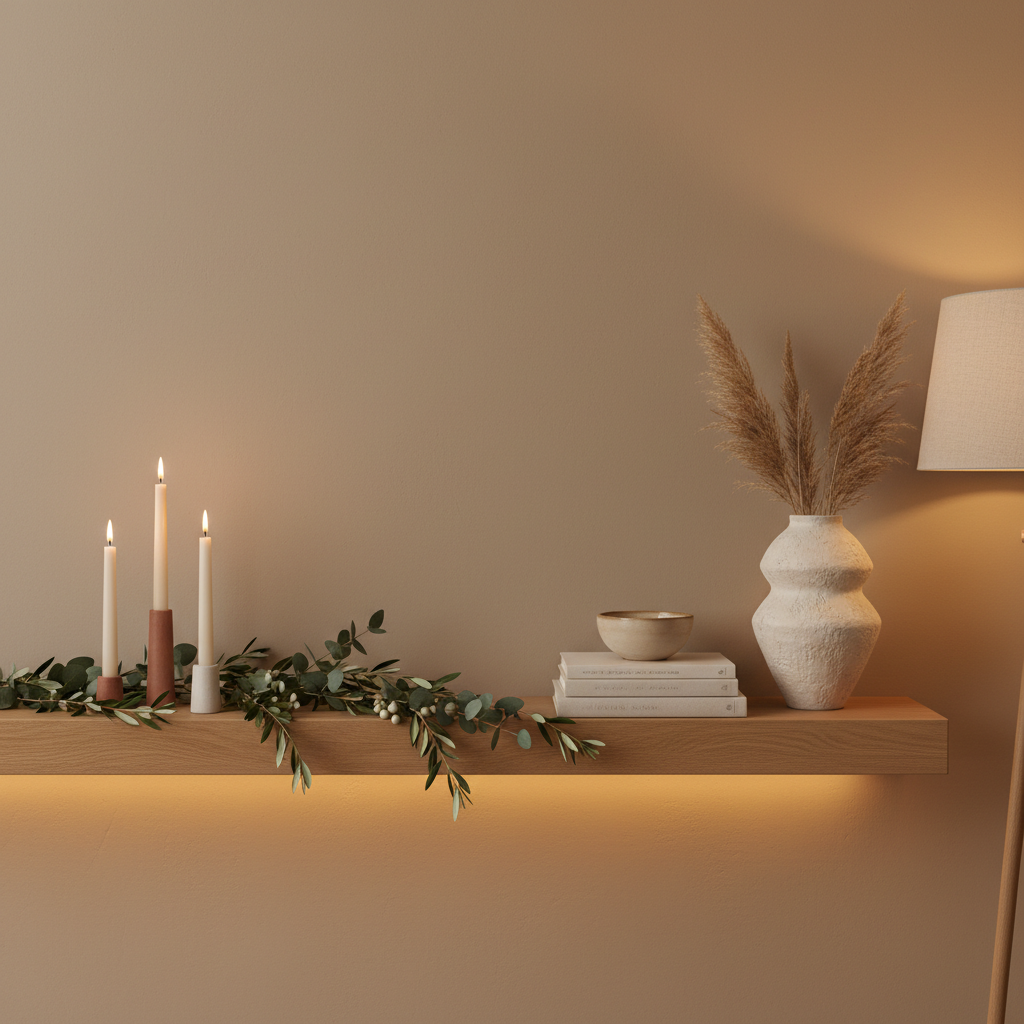
Seasonal swaps without redecorating the whole thing
If you like changing decor, build a stable base and rotate only two or three pieces. This avoids the “I bought a cart of seasonal stuff and now it’s chaos” situation.
| Base pieces (stay) | Swap pieces (seasonal) | Quick color cue |
|---|---|---|
| Large mirror or art | Garland, stems, or branches | Green + warm white |
| Stacked books + tray | Candles, mini ceramics | Terracotta, amber |
| One tall vase | Seasonal florals | Soft pastels |
| Sculptural object | Holiday accent (one) | Metallic accent |
Key point: swap items with similar size, not just similar theme. Scale consistency keeps everything looking calm.
Common mistakes (and the small fixes that change everything)
Some issues show up again and again, especially when a mantel exists without the “reason” of a fireplace.
- Too many tiny decor pieces: Replace five small items with one medium bowl or a tray that groups them.
- Everything centered: Slide your main art slightly off-center and build a stronger cluster on one side.
- Matching sets everywhere: Symmetry can work, but full matching pairs often feel staged, mix one side.
- Ignoring cords and outlets: If you add a lamp, plan a clean cord path, cord covers help.
- Over-theming: A mantel without fire reads better when it feels like art styling, not fireplace cosplay.
And yes, sometimes the fix is boring: remove two objects, lower the art, and add one larger piece. That’s often the whole problem.
When it’s worth getting professional help
If your questions are mostly “Where do I put this vase,” you can DIY. If your questions are “Will this fall,” pause and get help.
- Heavy mirrors or large frames: Consider a handyman or installer, especially if studs aren’t where you need them.
- Electrical plans: If you want sconces or hidden outlets, a licensed electrician is the safer route.
- Rental restrictions: Some walls need specific anchors or patch plans, check your lease.
- Full-room balance issues: An interior designer can help if the mantel problem is really a layout problem.
According to CPSC (U.S. Consumer Product Safety Commission), tip-over and falling hazards are a real home safety concern, so for large mounted items, using appropriate hardware and installation methods matters. If you’re unsure, a professional opinion is usually cheaper than repairing damage.
Conclusion: a mantel without a fireplace can look more modern, not less
Once you stop trying to make the mantel “act” like a fireplace, the styling choices get clearer. Pick a role for the shelf, use a layout formula, then build layers with one strong backdrop and a few pieces that vary in height and texture.
If you want a simple next step, take a photo of your mantel from across the room, remove two small items, then add one larger anchor object. That quick reset solves a surprising number of setups, and it makes the next round of tweaks feel obvious.
Quick takeaways
- Scale beats theme: size relationships matter more than matching decor styles.
- Limit “small stuff”: group with a tray or replace with one medium piece.
- Swap smart: rotate 2–3 seasonal items, keep the base consistent.
FAQ
- How do you decorate a mantel without a fireplace so it doesn’t look fake?
Skip fireplace-coded props like tools and faux logs, and style it like a shelf vignette with art, books, ceramics, and a clean mix of heights. - What should be the main focal point above a mantel with no fireplace?
A large mirror or one substantial art piece usually reads most intentional, especially when it’s sized to 60–90% of the shelf width. - Can I put a TV above a mantel shelf without a fireplace?
In many homes, yes, but it depends on wall structure, viewing height, and wiring. Keep decor low and avoid reflective items that create glare. - How many items should be on a mantel shelf?
There’s no magic number, but if you’re styling a standard-width shelf, 5–9 items grouped into 2–3 clusters often looks balanced, as long as there’s negative space. - How do I decorate a narrow mantel ledge?
Prioritize flat layers: a leaning frame, one slim vase, stacked books, and a shallow tray. Deep objects make narrow ledges feel cramped fast. - What colors work best for a modern mantel without a fireplace?
Neutrals with one accent color typically look clean, especially if the accent repeats once or twice. Too many bright colors can make the shelf feel busy. - Is it okay to use candles on a mantel shelf?
Usually yes, but be cautious with open flames near greenery, frames, or low shelves. Many people prefer flameless options for peace of mind, and if you have concerns, ask a home safety professional.
If you’re decorating a mantel without a firebox and you want it to feel “finished” without buying a cart of random decor, it often helps to start with one properly sized art piece and a short list of versatile anchors, then build seasonal swaps around them.