
How to organize pet toys in living room bins comes down to two things: making it easy to put toys away fast, and making it obvious where each type of toy belongs.
If your living room keeps turning into a toy minefield, it’s usually not because you “need more storage.” It’s because the system asks too much of you in the moment, especially when you’re tired, your dog wants to play again, or you’re trying to tidy up before guests show up.
This guide walks through a realistic setup for bins you already have, plus a few upgrades that help the system stick: simple categories, “one-hand” access, labels that make sense, and a weekly reset that prevents the slow creep back to chaos.
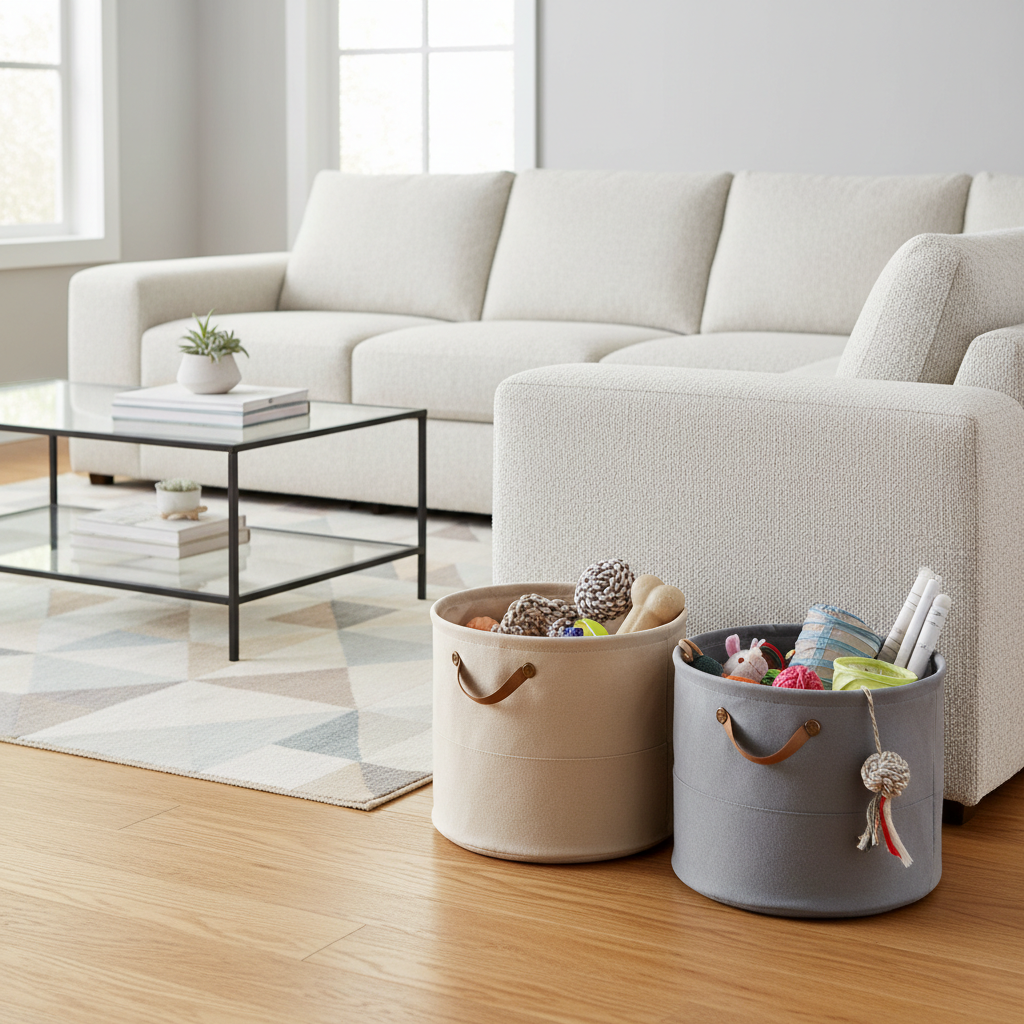
Start with the “living room reality” (why most bin systems fail)
Most people try to organize pet toys like pantry items: lots of tiny categories, perfect labels, everything lined up. But living rooms work differently, because the storage is used in motion, often while supervising kids, answering the door, or stepping around a wiggly pet.
In many homes, bin setups fail for predictable reasons:
- The bin is too deep, so toys disappear and never get rotated.
- The opening is annoying (lid, latch, tight shelf), so toys end up on the floor instead.
- Too many “rules”, like separating every toy type, so nobody follows the system.
- No boundary for quantity, so you keep adding until the bin becomes a junk pile.
So before sorting anything, decide what your living room bins need to do: quick cleanup, quick access, and a clear “stop point” when you have too much.
A quick self-check: which toy clutter problem do you actually have?
Different clutter patterns need different fixes. Pick the one that sounds most like your house right now.
- “Everything is everywhere”: You need fewer categories and a larger “catch-all” zone.
- “The bin is full but the floor is still messy”: You need a 2-minute nightly sweep routine and better bin access.
- “My pet pulls everything out”: You need a lid, a higher placement, or toy rotation.
- “We have too many toys”: You need a limit rule and a donation/trash decision pass.
- “Some toys are gross”: You need a washable liner, a ‘to-clean’ pouch, and separation by material.
According to AVMA (American Veterinary Medical Association), choosing appropriate toys and regularly checking them for damage helps reduce choking and injury risks. That safety angle matters here because organized bins make it easier to see what’s worn out.
Set your categories (keep it simple, then earn complexity)
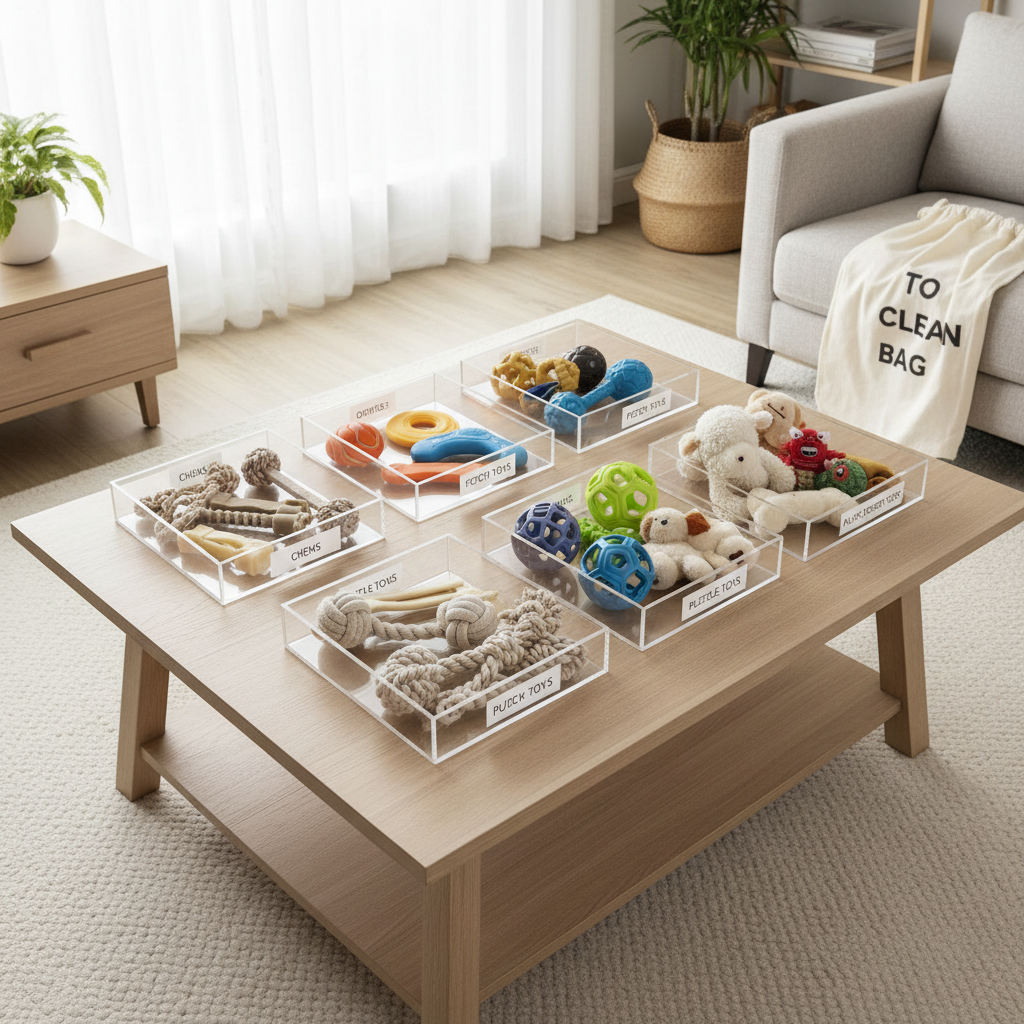
The biggest win for how to organize pet toys in living room bins is limiting categories to what you’ll actually use. In most living rooms, 3–5 buckets is plenty.
A practical category set for most homes
- Chews (bully sticks, nylon chews, rubber chews)
- Fetch & active play (balls, frisbees, tug toys)
- Puzzles & enrichment (treat puzzles, snuffle items)
- Comfort (plush toys, “favorite” toys)
- To-clean / damaged (small bag or box inside the bin)
If you share toys across dog/cat households, add one more divider: “cat only” vs “dog only.” Otherwise, keep it lighter.
Choose the right bin setup for your living room (table + options)
Not all living rooms tolerate the same storage style. If you have a curious puppy, a toy-dumping dog, or a minimalist space, the “right” bin looks different.
| Living room situation | Bin type that usually works | Why it helps |
|---|---|---|
| High-traffic space, fast cleanup needed | Open-top woven bin or fabric cube | One-hand toss-in, low friction |
| Dog pulls toys out constantly | Lidded bin or bench storage | Reduces self-service dumping |
| Small apartment, limited floor space | Under-console low bin or shelf baskets | Uses “dead” space without visual clutter |
| Mixed toy types, want quick visibility | Shallow bin + dividers | Less digging, easier toy rotation |
| Messy toys (drool, outdoor dirt) | Plastic bin with washable liner | Easier wipe-down, less odor |
One small rule that changes everything: keep the bin no more than about “forearm deep.” If you have to dig, you stop using the system.
Step-by-step: organize your living room toy bins in 30–45 minutes
This is the part people overthink. Don’t aim for perfection, aim for a system that survives real evenings.
1) Do a fast safety and condition pass
- Throw out toys with loose strings, exposed stuffing, cracked plastic, or sharp edges.
- Set aside anything that needs washing in a “to-clean” bag.
- If you’re unsure what’s safe for your pet’s chewing style, it may help to ask your veterinarian for guidance.
2) Create a “favorites live here” rule
Pick 3–6 toys your pet uses most and keep them in the easiest-to-reach zone, like the front of the bin or the top layer. The rest can rotate.
3) Add simple separation without over-building
- Use one small basket inside the larger bin for chews (keeps crumbs contained).
- Use a zip pouch for small enrichment pieces (prevents the tiny-part avalanche).
- If you use a fabric bin, add a washable liner if drool smell tends to build up.
4) Label for humans, not for aesthetics
Labels only work if other people can decode them in two seconds. “Chews,” “Balls,” “Puzzle,” “Cat” beats cute labels every time. If you hate visible labels, place them inside the rim.
Make it stick: 3 routines that stop the clutter from coming back
Even a great setup collapses if there’s no maintenance rhythm. The trick is keeping it short.
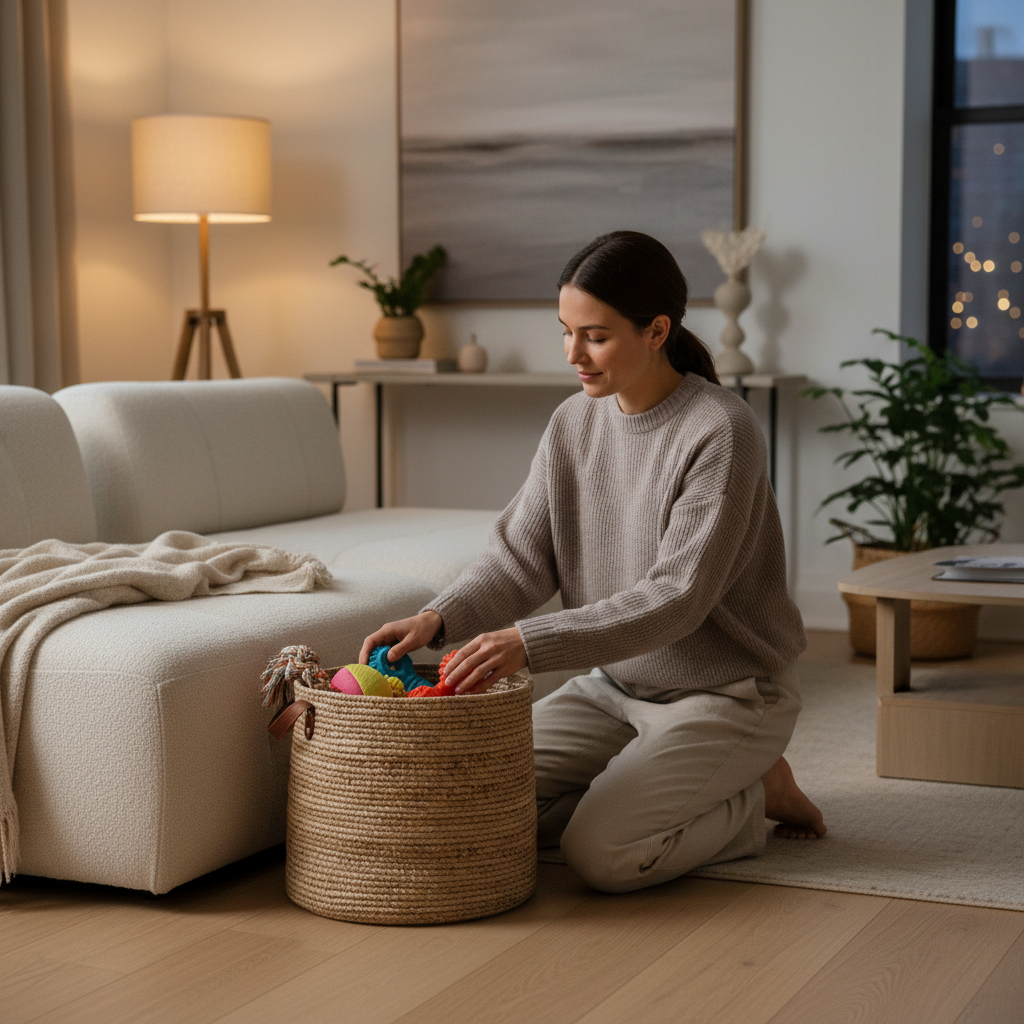
- The 2-minute nightly sweep: toss everything back into the bin, no sorting required. Sorting happens weekly.
- Weekly “reset + rotate”: remove all toys, wipe the bin, swap 2–3 toys in/out so your pet stays interested.
- The one-in, one-out rule: when a new toy arrives, donate or discard one older toy (or move it to a closet rotation box).
If you’re trying to figure out how to organize pet toys in living room bins for a household with kids, give them a single job: “everything goes in the bin,” not “sort each toy.” That’s usually where families get stuck.
Common mistakes (and what to do instead)
- Mistake: buying more bins before reducing toy volume.
Try this: set a firm capacity limit, then store overflow in a separate rotation box outside the living room. - Mistake: using a lidded bin that’s annoying to open.
Try this: choose a lid that flips easily, or keep one open “daily bin” plus one closed “backup bin.” - Mistake: mixing messy chews with plush toys.
Try this: separate by “clean” vs “drooly,” even if you don’t separate by type. - Mistake: organizing for looks, not behavior.
Try this: keep the most-used toys at the top, even if it’s not Instagram-perfect.
Also, if your pet guards toys or becomes possessive around bins, be cautious about encouraging “self-serve” access. In some cases, it’s better to keep toys stored and bring them out intentionally, and if the behavior escalates, a qualified trainer may help.
Key takeaways you can use today
- Fewer categories wins in a living room: 3–5 groups is usually enough.
- Shallow, easy-access bins get used more than perfect-looking bins.
- Add a “to-clean / damaged” zone so questionable toys stop cycling back onto the floor.
- Use routines (nightly sweep, weekly reset) instead of constant micro-sorting.
If you implement just one change, make it this: set a capacity limit and stick to it. That single boundary keeps the whole system from quietly failing.
FAQ
How many living room bins do I need for pet toys?
For many homes, one main bin works, plus one small insert (or pouch) for chews or tiny parts. If you’re adding a second full bin, it often signals you need rotation storage elsewhere.
What’s the easiest way to organize pet toys when my dog dumps the bin?
Use a lidded bin or place the bin on a higher shelf where you control access. Another option is a smaller open “daily toys” basket and keeping the rest out of reach.
How do I keep pet toys from smelling inside storage bins?
Separate “wet/drooly” items from plush toys, add a washable liner, and do a weekly wipe-down. If odor persists, it may mean a few toys need replacing rather than more air fresheners.
Should I separate toys by type or by pet (dog vs cat)?
If both pets share the living room, separating by pet can reduce chasing and conflicts, especially around catnip toys. If conflict isn’t an issue, sorting by function (chew, fetch, puzzle) tends to be simpler.
How often should I rotate pet toys from the living room bins?
Weekly rotation works for a lot of households, but the right pace depends on how quickly your pet gets bored and how many toys you own. If you notice frantic “digging,” rotation may be overdue.
Where do I put enrichment puzzles so pieces don’t get lost?
A zip pouch or small lidded box inside the main bin keeps parts together. If your pet is a strong chewer, pick a container they can’t access unsupervised.
Is it okay to store chew sticks and edible chews in living room bins?
It can be, but many edible chews do better sealed for freshness and to reduce odor. If you store them in the living room, use a separate closed container and monitor for any signs of spoilage.
If you’re trying to reorganize a living room that has to look decent for guests and still function for daily pet life, a simple bin system plus a quick reset routine usually beats fancy storage. If you want, share what kind of bins you have now and whether your pet dumps them, and I can suggest a setup that fits your exact layout.